Touch creates information
Soft, firm, rough, smooth, dry, wet, flexible, and rigid materials help children build rich descriptive concepts.
Simple hands-on experiences that invite children to touch, move, notice, compare, create, and discover.
Sensory play gives children meaningful ways to explore the world through texture, movement, sound, shape, pressure, balance, and repetition. The most useful experiences are often simple: materials children can manipulate freely, familiar objects they can investigate in new ways, and enough time to follow their own curiosity.
Children learn by doing the same small experiments adults often overlook: pouring, pressing, squeezing, sorting, scooping, balancing, rubbing, listening, and comparing.
These actions help children gather information about materials while practicing coordination, attention, language, planning, and flexible thinking. A sensory experience does not need to be elaborate to be valuable. A tray, a few safe objects, and one simple invitation can create enough space for meaningful discovery.
Start with fewer materials than you think you need. Add more only when the child begins to look for a new challenge.
Soft, firm, rough, smooth, dry, wet, flexible, and rigid materials help children build rich descriptive concepts.
Scooping, transferring, carrying, stacking, and balancing connect thinking to physical action.
Repeating the same movement lets children refine force, accuracy, timing, and coordination.
Words such as heavy, sticky, full, empty, more, less, slow, fast, bend, pour, and press become meaningful during real action.
Open-ended materials allow children to decide what to try, change, combine, repeat, or leave alone.
Texture, temperature, pressure, and resistance.
Balance, carrying, reaching, pushing, and pulling.
Shaking, tapping, pouring, rolling, and listening.
Pattern, quantity, motion, shape, and visual change.
Force, position, effort, coordination, and control.
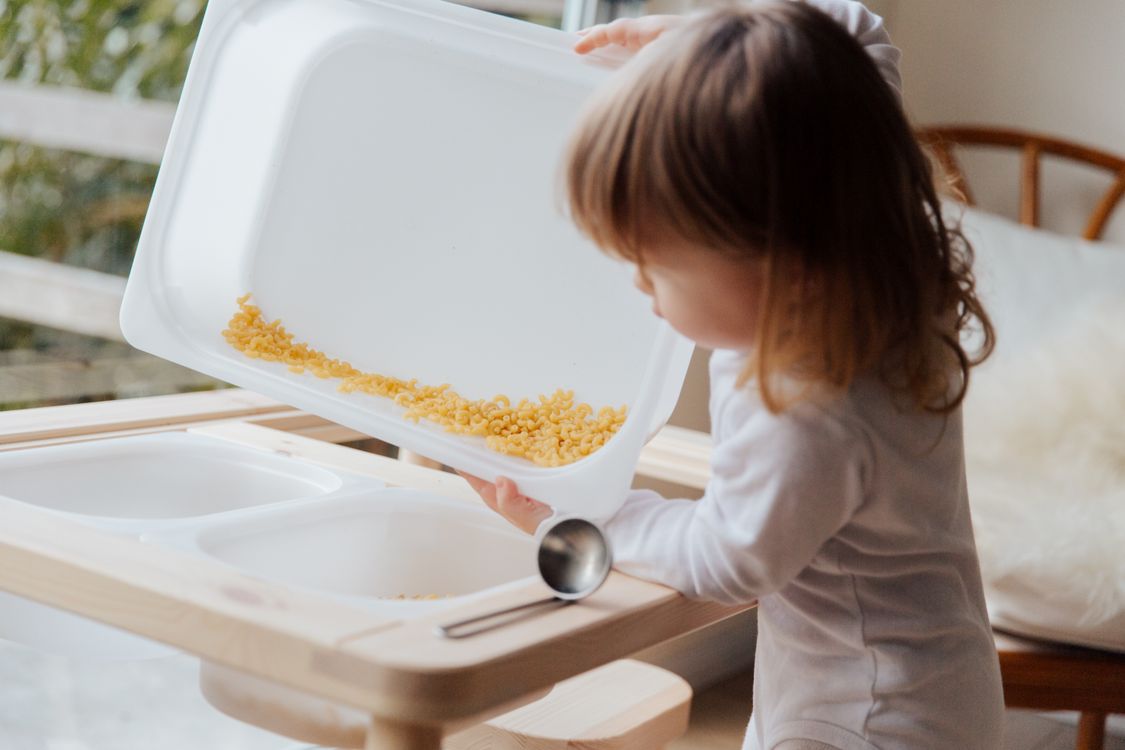
A contained play space makes open-ended exploration easier for children and easier for adults to manage.
Start with one base material and two or three tools. A scoop changes the task from touching to transferring. A cup introduces volume. Two containers create comparison. A pair of tongs adds fine motor challenge. The same material can support many different skills without replacing the entire activity.
Each idea can be adapted with materials you already have. The purpose is not to create a perfect setup. It is to give children a clear invitation with enough freedom to explore in their own way.
Place a safe dry material in one container and leave a second container nearby. Add a scoop or cup. Children can fill, empty, compare, spill, gather, and repeat while developing hand control.
Offer a small collection of safe objects with contrasting surfaces. Invite the child to find pairs, group similar textures, or describe how each object feels.
Roll, flatten, pinch, poke, pull, and press dough or another child-safe moldable material. Add simple tools only when the child is ready for a new challenge.
Use blocks, stacking pieces, or other stable objects. Children learn to adjust force and placement while discovering why some arrangements stay upright and others fall.
Tap, shake, roll, and pour a few safe objects. Compare loud and quiet, fast and slow, heavy and light, or long and short sounds.
Offer objects that can be sorted in several ways. Instead of giving one rule, ask what the child notices. They might sort by shape, texture, size, use, or weight.
Create a simple path using safe balance toys, floor markers, cushions, or low stepping elements. Invite walking, stepping, reaching, carrying, and changing speed while maintaining control.
The value often comes from the thinking that happens while children manipulate materials, notice results, adjust their actions, and try again.
Pinching, scooping, transferring, pressing, stacking, and turning build precision and hand strength.
Children learn to adjust strategies when objects spill, structures fall, tools do not fit, or materials move unexpectedly.
Sensory experiences create natural reasons to describe texture, movement, quantity, size, force, and change.
Repeated actions help children remain engaged with one process long enough to notice patterns and refine control.
Sensory play becomes meaningful when children have enough freedom to notice what their own actions can change.LearnCove play principle
Moldable materials invite children to notice exactly how much force an action requires.
Press lightly and the surface changes a little. Press harder and it changes more. Roll with one hand and the shape responds differently than when both hands work together. These simple cause-and-effect relationships support motor planning and experimentation while giving children a direct way to create.
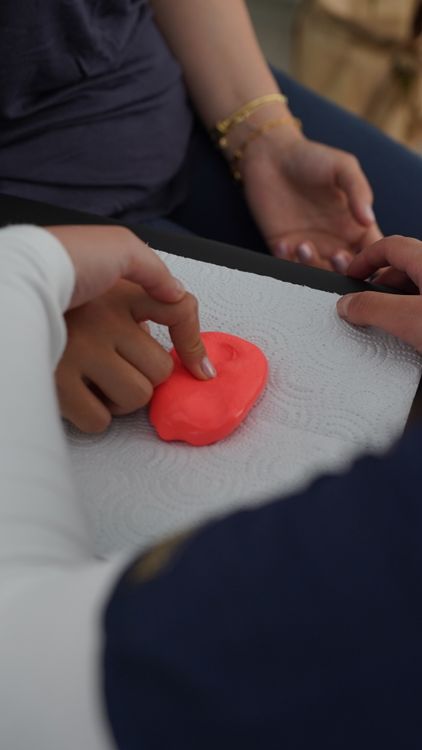
Repeating familiar setups with a small variation helps children deepen their skills while keeping preparation simple for families.
Transfer one material between two containers using hands, a cup, or a simple scoop.
Group a small collection by texture, shape, size, or another feature the child notices.
Use a moldable material for rolling, flattening, pinching, and shaping.
Stack and balance pieces while testing which arrangements are strong and stable.
Compare the sounds created by tapping, rolling, shaking, or pouring safe objects.
Add a simple whole-body challenge involving stepping, balancing, carrying, or reaching.
These setups are intentionally flexible. Adjust materials and difficulty to suit the child’s age, abilities, interests, and supervision needs.
Place a small quantity of safe material beside two containers. Let the child transfer by hand before adding a tool.
Hide a few larger safe objects within a sensory material and invite the child to search, identify, and sort what they find.
Offer pairs of materials with similar surfaces and invite matching by touch or by visual comparison.
Press safe shapes into a soft moldable material and compare the marks they leave behind.
Arrange stacking pieces from large to small, then change the order and see which towers remain stable.
Roll objects with different shapes and sizes across a safe surface. Compare which move straight, wobble, stop, or travel farther.
Explore which actions create softer sounds and which create louder sounds using a small group of safe objects.
Create a simple movement path with safe balance elements and invite slow steps, pauses, turns, and controlled carrying.
Combine classification and construction by sorting pieces first, then using each group to build a different arrangement.
The child begins using smaller movements, spills less, changes grip, or adjusts pressure more deliberately.
The child remains with one action longer, repeats an experiment, or returns to an earlier idea after trying something new.
The child pauses before acting, selects a tool intentionally, or changes the arrangement to solve a problem.
The child uses more precise words to describe texture, quantity, motion, force, position, or change.
The child tries another method when a tower falls, a scoop spills, or a material behaves differently than expected.
The child begins setting up familiar actions, choosing tools, or extending the play without waiting for an adult direction.
The child combines materials in a new way, creates a pretend context, or invents a different use for a familiar object.
A small shift in adult language can protect curiosity and give children more ownership over what they are discovering.
Try: “You have two places it could go. Which one do you want to test first?”
Try: “You found a different way to use that tool. What happens when you move it like that?”
Try: “I notice you keep repeating that movement. What are you watching for?”
Try: “You changed the bottom pieces until the tower stayed up. That took careful planning.”
Sensory play becomes richer when materials offer a clear physical response to the child’s actions.
LearnCove categories support a broad range of sensory experiences, from tactile and fine motor exploration to balance, sorting, construction, creative expression, and early problem solving. The strongest choices are versatile enough to be used in more than one way.
Materials and objects that support texture, touch, motion, manipulation, and repeated sensory exploration.
Purposeful hands-on materials that encourage order, control, matching, repetition, and self-directed discovery.
Movement-based play for balance, body awareness, coordination, confidence, and motor planning.
Materials for classification, sequencing, construction, comparison, and visual-motor control.
Drawing, pressing, shaping, tearing, arranging, and tactile creative expression.
Hands-on experiments that encourage prediction, observation, comparison, testing, and cause-and-effect thinking.
Opportunities to notice visual differences, classify features, match patterns, and build descriptive vocabulary.
Counting, grouping, comparing, quantity, pattern, and spatial reasoning through hands-on materials.
Choose materials and supervision based on the individual child, especially when activities include small parts, loose materials, or objects that could be mouthed.
Consider age, developmental stage, mouthing behavior, coordination, and individual needs before choosing materials.
Stay close enough to support safe use and intervene when a material or action is no longer appropriate.
A defined tray, mat, or play area helps children understand where materials belong while making cleanup more predictable.
Short successful experiences make it easier to return to the activity with curiosity another day.
Every question is closed by default so families can open only the information they need.
Assistance is available around the clock.
Every product order ships without a shipping charge.
A clear delivery window for U.S. customers.
A flexible post-purchase experience for families.

